
Action regulation ensures that the key, wippen and hammer are in the correct geometric relationships and alignments so that:
- the whole hammer blow cycle completes without failing;
- power transfer from finger to hammer is maximised;
- repetition rate is maximised;
- aftertouch feels the same across the keyboard.
Key Height. The distance of the front edge of the white key tops to the keybed. It is regulated by varying the thickness of the balance rail punchings (or diameter of the balance rail bearing if present). Typical values range between 63mm and 67mm. It specifies the key elevation that is appropriate for good fit in the piano model’s case.
Black keys are set at between 12.0mm to 12.7mm above the white keys, so that they remain about 1.5mm above the white keys when fully depressed.
Key Dip. The distance that the front of the key (at the front rail pin) travels downwards from rest position until it is stopped by the front rail punchings. Key dip is measured 13.0mm from the front edge of the key, and regulated by varying the thickness of the front rail punchings. In modern pianos, white key dip ranges from 9.5 – 11.0mm. Key dip for black keys is set by matching their feel to that of the adjacent white keys. Then refined when regulating aftertouch.
Blow Distance. The distance the hammer (crown) travels from its rest position to strike the strings, i.e., practically, the distance travelled by the 3-lever system’s resistance arm 3B. It is standardised to between 45mm to 48mm, and is regulated by adjusting the height of the key’s capstan screw underneath the wippen cushion.
Backchecking Height. The distance from the strings at which the backchecks ‘catch’ and hold the rebounding hammers. Backchecking speeds up repetition by preventing the hammer from getting too far from the strings after strikes that involve keeping the key depressed (legato, tenuto). Values range between 12.0mm and 15.0mm, and it is regulated by adjusting the back check’s distance from the hammer tail. The higher checking happens, the faster the hammer returns to the strings on re-strike.
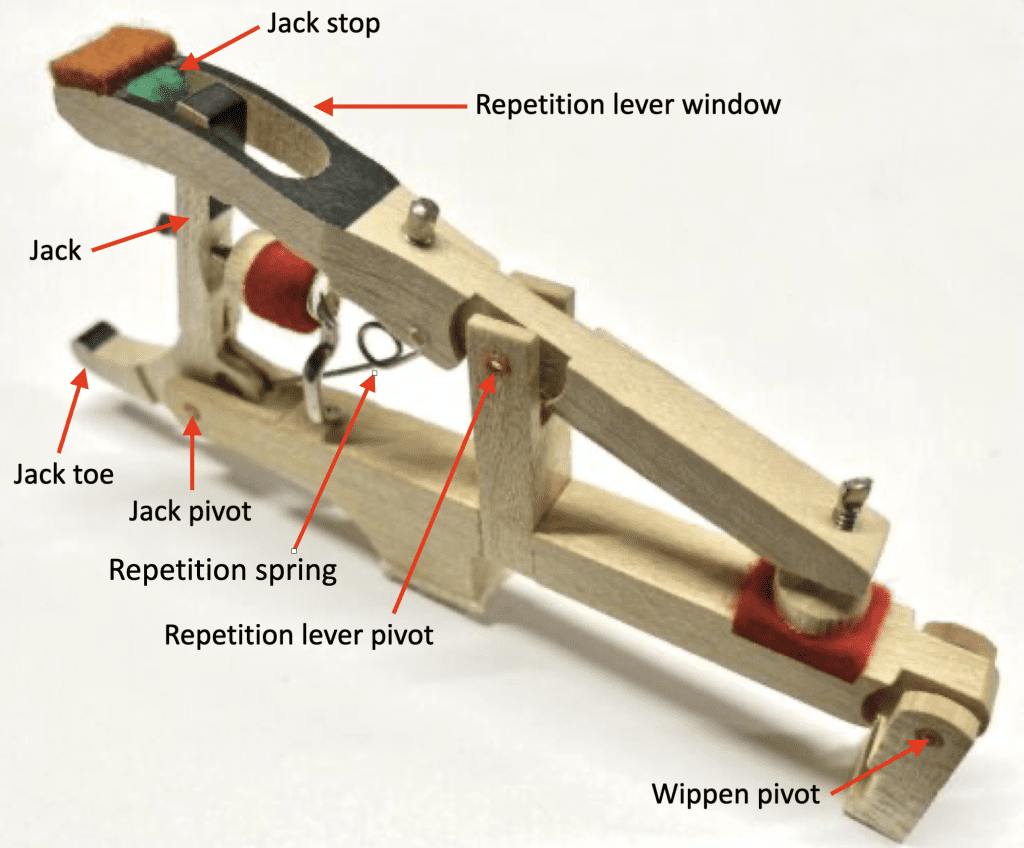
Repetition Spring Tension. The speed of repetition is affected to a great degree by the tension of the spring inside the wippen. To check repetition spring tension, play the note into check with a moderate stroke, then release the key a little until the hammer swings up and stops at the drop position. The motion should be decisive, quick but not jerky, and without fluttering at the drop position.
Jack to Knuckle Alignment. The rear edge of the jack must be aligned with the rear edge of the knuckle core. This puts the back part of the jack square to the knuckle core, thereby maximising power transfer and minimising friction when the let-off button trips the jack.
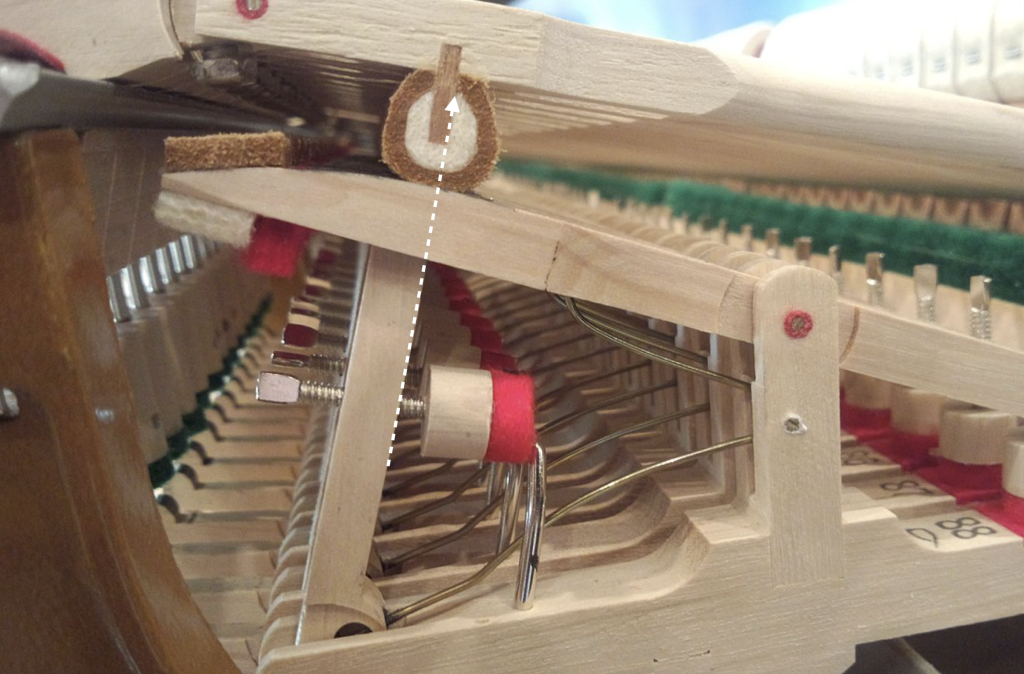
Repetition Lever Height (above the jack). The jack must sit just below the repetition lever window so that it just barely kisses or just barely misses the underside of the knuckle’s centre. This is to ensure the jack’s return to its position under the knuckle is not impeded or slowed down by interference from the knuckle. It also maximises responsiveness and the transfer of power from jack to hammer because there is little or no lost motion in jack travel before engaging the knuckle.
Let-Off. This is the distance between the strings and the highest point of the hammer’s travel that is still supported by the jack. It is the closest distance to the strings that hammers can be safely released to strike the strings with as much momentum as possible without blocking or double-striking. It typically ranges from 3.0mm to 1.5mm (bass to treble), and is regulated by adjusting the let off button to trip the jack at the desired distance.
Drop. The repetition lever is stopped when it contacts the drop screw in the hammer flange. Drop is the closest distance that the repetition lever can bring the hammer to the strings. Well-regulated drop helps to make the action feel smoother and more predictable, and ensures rapid repetition (provided repetition spring tension is adjusted correctly).
The drop is adjusted until the repetition lever contacts the drop screw at the same time as the jack toe contacts the let-off button. If adjusted accurately, the drop distance will be the same as the let-off distance, and no closer. However, there is a thin but indistinct line between being ‘at let-off’ and ‘closer than let-off’. Too close and the hammer will bobble and double-strike when the note is played softly. Too much impairs the repetition rate, and also makes the action feel heavy, unresponsive and spongy.
Therefore, for safety reasons, drop is typically set at around 1.5mm to 2.0mm lower than let-off.
Aftertouch. This is the distance travelled by the key, after let-off, to the bottom of the key stroke (where the key is stopped by the front rail punchings). It must be sufficient to allow the jack to move forward after let-off so that there is no contact with the knuckle after let-off. A gap of no more than 1mm is enough. The jack should travel no more than halfway towards the jack stop in the repetition lever window.
Aftertouch is typically 1.0 to 1.5mm with little variation, other than small incremental adjustments to make sure. It cannot be much more than that, otherwise it wastes finger motion, slows repetition, and interferes with the functioning of the action (e.g., when excessive aftertouch causes downward key movement to be stopped by the jack hitting the jack stop, instead of the key hitting the front rail punchings).
One sure sign of a high-quality regulation is aftertouch that feels the same across the keyboard.