
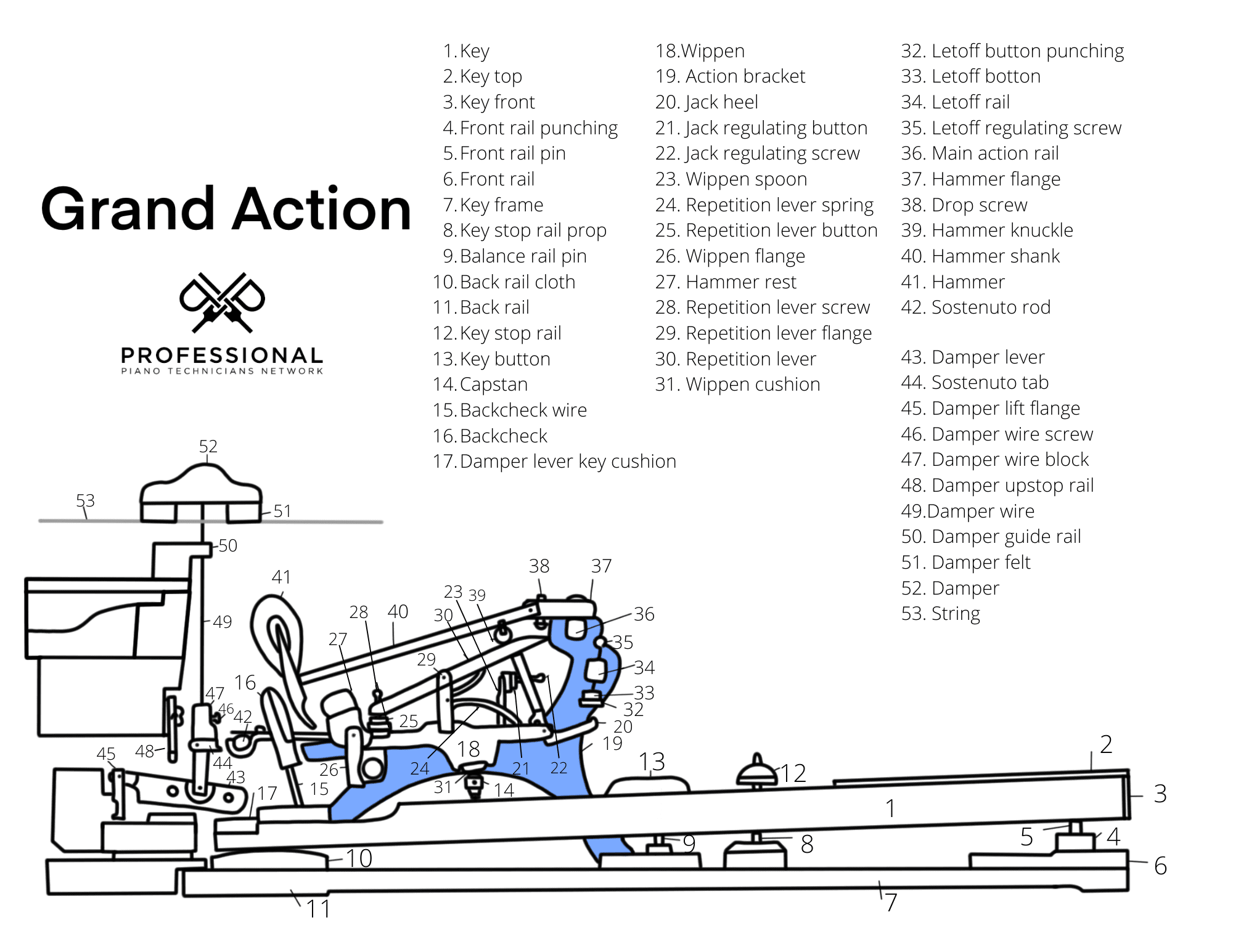
The modern piano has its origins in the fortepiano’s hammer action, invented around 1700 by the Italian harpsichord maker Cristofori. It improved on the earlier harpsichord and clavichord by being louder with more sustain, and offered dynamic expressive control over individual notes. It was further improved around 1820 by the French piano manufacturer Sébastian Érard who invented the double escapement action. This incorporated a repetition lever (also called the balancier) that let the pianist quickly play a note again, even if its key had not yet returned to its rest position. This facilitated rapid playing of repeated notes.
The piano’s design was driven by the desire for a stringed keyboard instrument that gave the pianist a wider palette of tonal colour, and sufficient loudness and sustain to project into a large concert hall and play in a large ensemble. The Industrial Revolution introduced new manufacturing processes that allowed piano designers to finally make such an instrument, comprising hammers of highly compressed felt striking plain and copper-wound steel strings strung at high tension across a massive cast iron harp.
- Most pianos have between 220 to 240 strings, each under about 70kg to 90kg tension;
- The compressive load that the strings put on the harp is between 16,000kg and 20,000kg;
- The strings exert a downward force on the bridge of around 1,000kg, or about 6% of the static tension.
The strings must be struck with enough force to make them vibrate. The mechanism that does this is the piano’s action. It is a lever that connects the player’s finger to the hammerhead in a way that converts the force of the finger on the key into a much larger force to drive the hammer towards the strings. Contact with the hammer is interrupted just before impact, so that the hammer is in free flight when it strikes (then rebounds) from the strings. This release of the hammer prevents it from blocking against (and stifling) the string.
Maximum transfer of power from finger to hammer occurs when:
- contact with the hammer is maintained for as long as possible;
- the hammer travels on an arc perpendicular to the keybed and strings; and
- the hammer strikes all of the note’s strings square-on and simultaneously.
Levers of the Grand Piano Action
The grand piano action is actually a system of three connected class 1 levers:
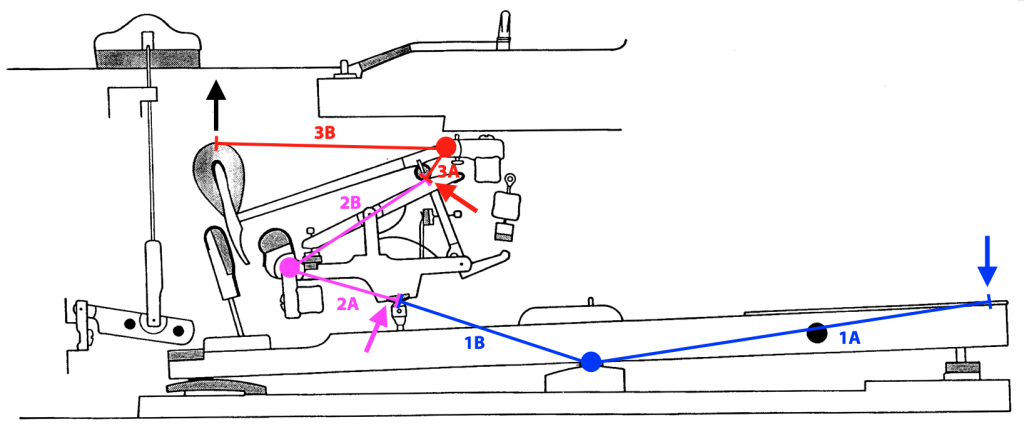
- Key (blue)
- 1A is the key lever’s effort arm (measured at 13mm from the key front);
- Fulcrum (blue dot) is the contact with the balance rail;
- 1B is the key lever’s resistance arm.
- The pianist’s finger pushing down on the front of the key at the blue arrow is the effort applied to 1A.
- The load moved by 1B is the combined weight of the wippen and hammer. The force exerted at the magenta arrow by the capstan screw against the wippen cushion is the effort applied to 2A.
- Wippen (magenta)
- 2A is the wippen lever’s effort arm;
- Fulcrum (magenta dot) is the wippen flange pin;
- 2B is the wippen lever’s resistance arm.
- The load moved by 2B is the weight of the hammer. The force exerted at the red arrow by the jack against the knuckle is the effort applied to 3A.
- Hammer (red)
- 3A is the hammer lever’s effort arm;
- Fulcrum (red dot) is the hammer flange pin;
- 3B is the hammer lever’s resistance arm.
- The load moved by 3B is the weight of the hammer head. The force exerted at the black arrow accelerates the hammer head towards the strings.
The action is therefore a compound lever with effort arm 1A and resistance arm 3B. It’s mechanical advantage is known as the action leverage or action ratio, and is typically around 5:1 to 6:1. The highly unequal ratio between the hammer’s effort arm 3A and resistance arm 3B is responsible for the final amplification of motion that makes the hammer move towards the strings at several times the rate of key movement. This rapid acceleration of the hammer’s mass generates the force needed to energise the strings and make them vibrate. This is very much like a motor vehicle’s gear box running in one gear with a fixed transmission ratio.
The Hammer Blow Cycle
We can now look at how the parts of the action operate and interact during one hammer blow cycle. After that, we will be ready to talk about action specifications and their regulation.
The four diagrams below describe how the key, wippen and hammer levers interact in the four phases of the hammer blow cycle—REST, ACCELERATION, LET-OFF, and CHECK.

- In rest position, the front end of the key is held up by the combined weight of the wippen and hammer holding down the back end of the key.
- The hammer rests (via its knuckle) on the side edges of the repetition lever window, and on the the tip of the jack that protrudes into the repetition lever window from below.
- The wippen rests on the capstan screw, which is screwed into the key.
- The damper is resting on the string, held down by weights.
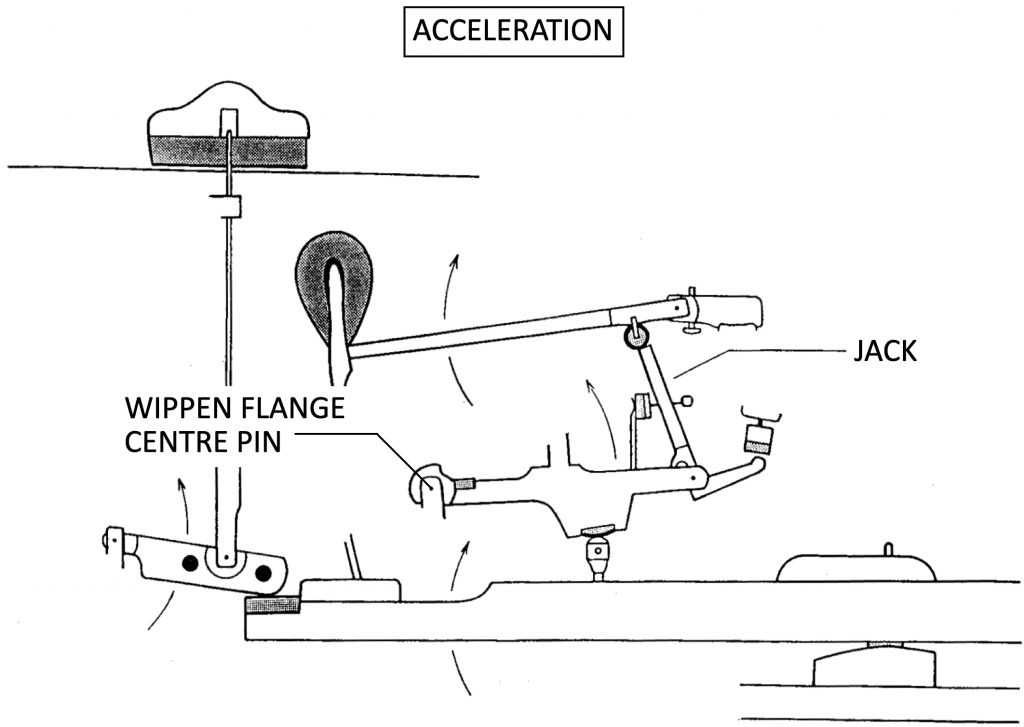
- Keys are pivoted at the balance rail pin. When the front of the key is depressed, the back end of the key rises, pushing the capstan screw upwards against the wippen cushion. This causes the wippen to rotate upwards around its pivot at the wippen flange centre pin.
- The rising wippen’s lightly spring-supported repetition lever begins to lift the hammer (via the knuckle). This helps to reduce the inertia that the jack has to overcome when it it too (almost immediately) begins to push upwards against the knuckle to accelerate the hammer towards the strings.
- The back end of the key starts to lift the damper when the hammer has traveled half of its distance to the string.
- Both jack and repetition lever drive the hammer towards the string.
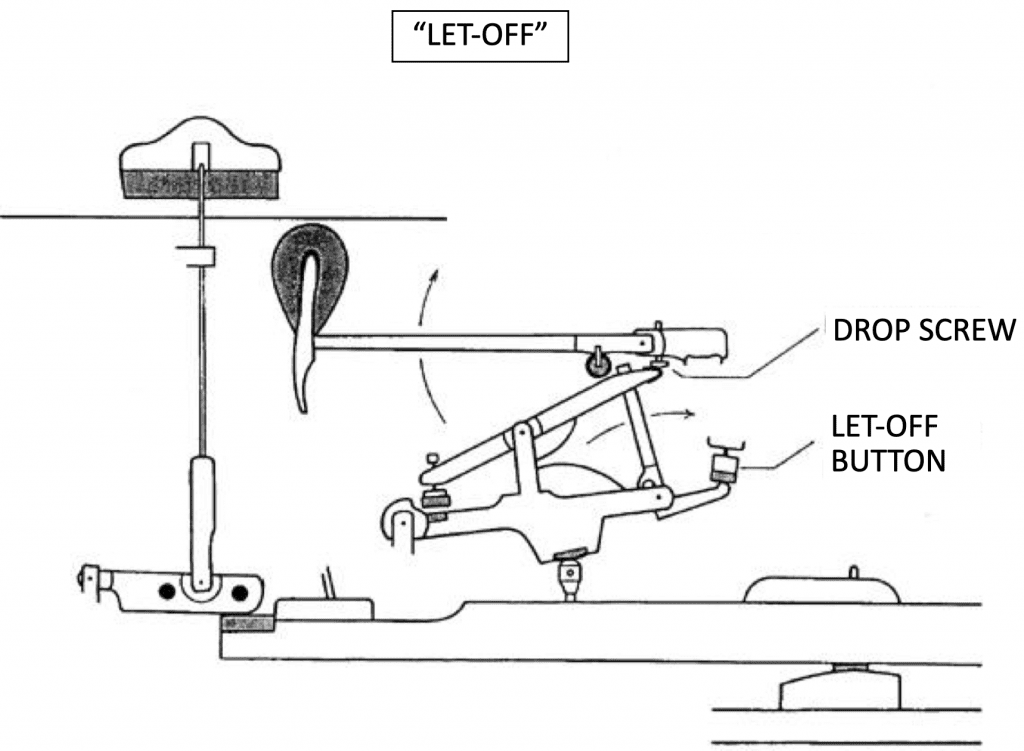
- During the let-off phase, all contact between the hammer and wippen is interrupted by a double escapement:
- The jack toe is stopped by the let-off button, and the jack is rotated away from under the knuckle by the rising wippen.
- At the same time, the tip of the repetition lever is stopped by the drop screw, and is held at that distance from the strings by upwards pressure from the repetition spring.
- The hammer (now in free flight) continues under its own momentum to strike the strings, then rebound from them. At the same time the key moves the remaining small distance to the bottom of the downward stroke where it is stopped by the front rail punchings.

- The rebounding hammer’s knuckle falls onto the repetition lever in front of the tripped jack. Momentum carries both hammer and repetition lever a short distance until the hammer (tail) is intercepted and held by the back check (located at the back end of the key).
- The stroke may now be repeated, either by releasing the key as normal and allowing it to return to the rest position, or by using the rapid-repetition feature.
- Normal release
- The key and all parts of the action return to their rest positions.
- Rapid repetition
- As the key is released and begins its upward return stroke, the back check moves away from the hammer tail and releases the hammer. The repetition spring pushes the repetition lever (and hammer) back up to drop distance, while pushing down the base of the wippen (and the back of the key). The wippen spring pulls the jack back under the knuckle as soon as the wippen drops enough for the jack toe to clear the let off button.
- The note is ready to played again when the key has travelled just 2.0mm of its upward return stroke.
- Fast repetitions (about 15 to 17 times a second) of the note are possible. The damper does not touch the strings until the repetition sequence ends and the action returns to its rest position.