
Class 1 Levers
Class 1 levers are the simplest kind of levers. Most of us have used them even if we didn’t know what they were, such as the playground see-saw.
- Effort – the amount of force applied by the user, also referred to as the input
- Fulcrum – where the lever pivots
- Load – the weight that needs to be moved, also referred to as the output.
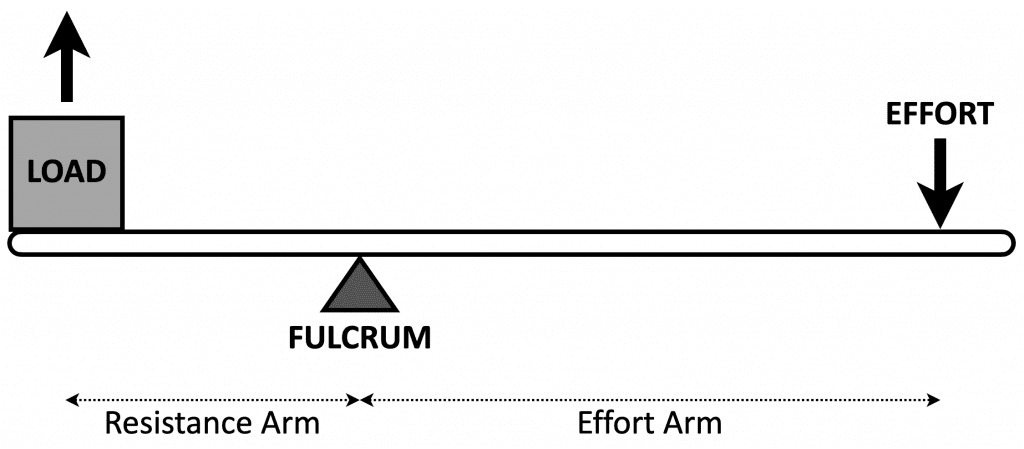
Levers are simple machines, and machines are used to augment the human effort needed to do something. Mechanical advantage is the amount of help you get when using a machine, in comparison to doing something with just human effort. It is derived by dividing the load by the effort needed to move it:
mechanical advantage = load ÷ effort.
For example, a lever that allows a person to lift a load of 200N with 100N of effort has mechanical advantage of 20 ÷ 10 = 2 (also written as the ratio 2:1).
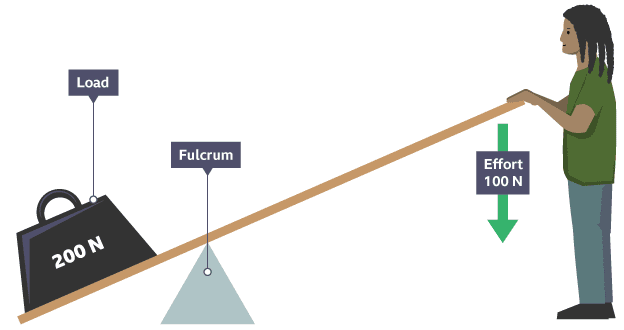
The lever’s mechanical advantage can also be calculated by taking the ratio of the effort arm length and the resistance arm length:
mechanical advantage = effort arm ÷ resistance arm
In the diagram below, the effort arm length is 6m while the resistance arm length is 2m. Therefore, mechanical advantage = 6 ÷ 2 = 3, i.e., 3:1.
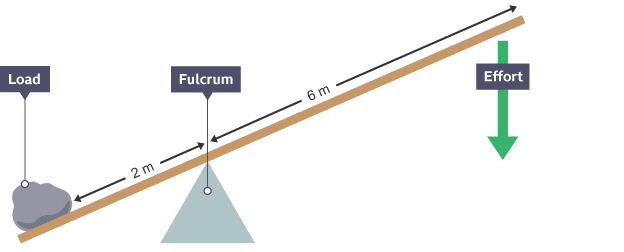
Note that it is not necessary for the effort and resistance arms to lie in a straight line. They can be at an arbitrary relative angle around the fulcrum.